700+
Species Living On Your Tongue
The tongue's surface is textured, which makes it the most populated site in the mouth. A film re-forms across it every night while you sleep.
Figure from published oral microbiome research.

Oral Care
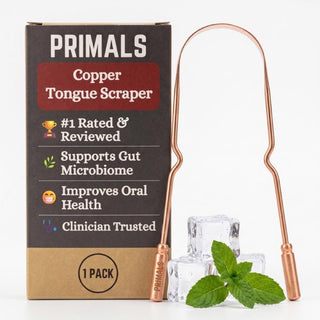
Solid copper, shaped for a two-second habit.
Start Here
Researchers have catalogued hundreds of bacterial species living on the human tongue. Overnight they build a film across it — the reason morning breath starts on your tongue rather than your teeth.
The tongue's surface is textured, which makes it the most populated site in the mouth. A film re-forms across it every night while you sleep.
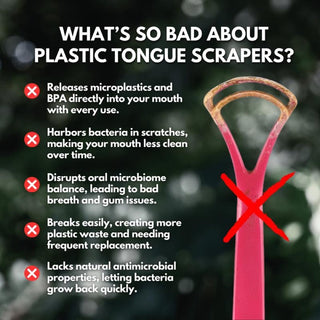
Figure from published oral microbiome research.Plastic is inert — it pushes the film around instead of killing anything on it. And every pass leaves micro-abrasions in the edge, which is exactly where bacteria sit out of reach of a rinse.
Refers to the material properties of plastic scrapers.Copper is naturally antimicrobial on contact, and a solid metal edge doesn't wear rough the way plastic does. Nothing to degrade, nothing to replace on a schedule.
Refers to the antimicrobial properties of copper surfaces.Why Copper
Copper is antimicrobial by nature — it is why hospitals have trialled it on door handles and why it has been used for water vessels for thousands of years.

Side By Side
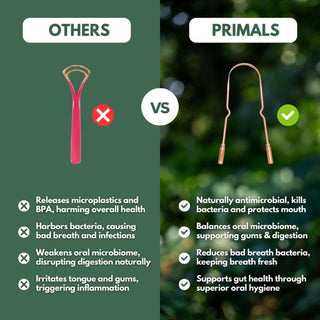
| PRIMALS Copper | Plastic Scraper | |
|---|---|---|
| Material | 100% solid copper | Moulded plastic |
| Effect on bacteria | Antimicrobial on contact | Inert — none |
| Surface over time | Stays smooth, develops a patina | Scratches harbour bacteria |
| Microplastics & BPA | Neither — no plastic present | Both possible |
| Coatings | None — bare metal throughout | Often painted or coated |
| Lifespan | Years — nothing to wear out | Replaced regularly |
| End of life | Fully recyclable metal | Landfill |
Comparison reflects typical plastic tongue scraper construction. Specifications vary by model and manufacturer.
The Method
First thing in the morning, before coffee or water. That is when the film is thickest and easiest to lift off in one pass.
Place it as far back as is comfortable and pull forward in one steady stroke. Rinse. Repeat three to five times.
Warm water, then dry it. Once a week, lemon and salt if you want the bright finish back. That is the entire maintenance routine.
Who It's For

Why They Switched
I used a plastic scraper for years thinking I was doing something good. Turns out I was spreading bacteria around and those tiny scratches were holding more of it. With the copper the white film genuinely lifts off. My breath stays fresh far longer.
He asked what had changed, because I stopped reaching for gum every morning. It is this. Simple swap, disproportionate difference.
She said my tongue looked healthier than she had seen it. The only thing I had changed in six months was ditching the plastic scraper for this one.
It feels like a real object — solid, weighted, and it came in a cotton pouch. Worth knowing the copper darkens after a couple of weeks. That is normal and lemon plus salt brings it back, but nobody told me beforehand so I thought I had ruined it.
The difference in how my mouth feels in the morning is not subtle. I only wish I had stopped using the plastic one years earlier.
Got one for me and two for my parents. Fair warning that the first few mornings set off my gag reflex until I worked out to start further forward. After that, no issue at all. Easiest health upgrade I have given anyone.
Before You Ask
Copper is naturally antimicrobial — bacteria that land on a bare copper surface are damaged on contact, which is why the metal has been used in water vessels and door handles for centuries. Plastic does the opposite: it scratches, and every scratch is somewhere for bacteria to sit. Steel is inert — better than plastic, but it does nothing to the bacteria itself.
Yes, and no. Copper develops a darker patina with air and moisture — that is the metal behaving normally, not a fault, and it does not affect how it works. If you prefer the bright finish, half a lemon and a pinch of salt brings it back in about ten seconds.
First thing in the morning, before you eat or drink. Stick your tongue out, place the scraper as far back as is comfortable, and pull forward in one steady stroke with light pressure. Rinse and repeat three to five times, until nothing more comes off. Then rinse the scraper and stand it dry.
Sometimes, at first. Start further forward than you think you need to and work back over a few days — the reflex settles quickly. Breathing out through your mouth as you scrape helps.
A brush agitates the coating; a scraper lifts it off and carries it out of your mouth. That is why the material matters — you are removing a biofilm, not redistributing it.
You shouldn't need to. Solid copper does not wear out, crack, or shed. Keep it clean and dry and it will outlast every plastic scraper you would otherwise have bought.
Rinse under warm water after each use and dry it. Once a week, give it a wipe with soap or the lemon-and-salt trick. Do not put it in the dishwasher — the detergent is harsh on copper.
The edge is rolled, not sharp, and light pressure is all it takes. If you have a tongue piercing, oral sores, or any condition affecting your mouth, check with your dentist first.
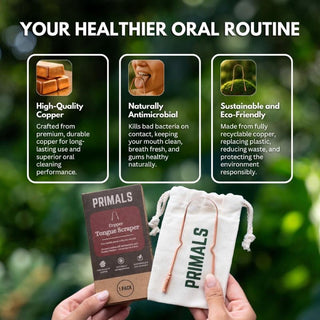
One solid copper scraper and a cotton travel pouch. That is the whole product — there is nothing to replace and nothing to run out of.
Email [support@yourdomain.com] and a person — not an autoresponder — replies the same business day. See our refund policy for the current returns window.
Covered
Every claim on this page is about what the scraper is made of — solid copper, and nothing else. If what turns up doesn't match that, email us and a person sorts it out the same day.
Stay In The Loop
Boar or horse? How often to swap? We'll send the one-page guide, plus early access when new bundles and colours drop.
No spam. Unsubscribe any time.